Understanding the Allure of Limited Edition Prints
Why Collectors Prefer Limited Runs
Ask a collector about the artwork and the conversation stays polite. Ask about the edition number, and they will lean in. That number changes how they value the piece!
A limited edition print arrives with a certificate of authenticity and the artist’s signature. Together, those elements build provenance. At an art print exhibition, the smallest editions draw the longest queues. I have watched collectors walk past larger works to reach a small edition run. The appeal is the limit itself, the knowledge that only a small number will ever hang on a wall.
Collectors give practical reasons for the preference:
- The edition number proves early access
- The signature forges a direct link to the artist
- The restricted run stabilises resale value
The difference between this print and an open edition is conceptual. Yet collectors are paying for that concept as much as for the image.
The Intersection of Affordability and Artistry
Limited editions occupy a specific position in the contemporary market. They are cheaper than an original canvas, though significantly pricier than a reproduction. That gap is where many South African buyers enter the art print exhibition scene for the first time.
Consider the arithmetic. A gallery painting might run into six figures. A run of fifty signed prints offers the same composition for a fraction of that amount. In my experience, first time collectors care about this equation.
- The print retains a direct connection to the artist’s hand
- The edition cap prevents the market from flooding
- The price point invites new buyers without cheapening the work
The category’s pull is the tension between the tactile and the conceptual. The paper, the ink, the registration of colour, these physical details carry meaning. Yet the value depends on the abstract promise of scarcity. At an art print exhibition, that duality surfaces in every conversation.
Digital Printing Techniques and Quality
Digital printing has transformed what a limited edition can be. At an art print exhibition in Cape Town, I watched a collector compare two proofs under a loupe. The difference was not in the composition, but in the micro details. A giclée print on cotton rag paper holds colour depths that lithography struggles to match. The ink sits on the surface in fine droplets, preserving the artist’s original brushwork.
Pigment-based inks are the standard for serious editions. They resist fading for decades, which matters in our climate. The printer must calibrate the monitor, the paper profile, and the pressure of the printhead. One slight misalignment turns a crisp line into a ghost.
Here is what separates a high quality digital print:
- The paper weight and texture affect how light bounces off the surface.
- The number of ink channels determines the subtlety of tonal shifts.
- The artist’s involvement in proofing ensures the edition matches the original.
That attention to detail is what makes an art print exhibition a space for genuine discovery.
Market Trends in Print Collecting
The average collector buys their first limited edition print before turning thirty. That statistic explains why the art print exhibition now draws a crowd that values research as much as impulse. Market trends in print collecting show a preference for works that fit into compact urban homes and survive relocation.
At a Durban venue, I hear buyers discuss edition numbers and archival boxes. They arrive prepared. They inspect the artist’s signature and the paper’s tooth.
- South African galleries report that prints outsell paintings in the under R10,000 bracket.
- Collectors resell editioned works through online auctions within a few years of purchase.
- The appeal lies in the fixed number, the guarantee of a finite set.
Galleries respond by hosting proofing sessions and open studios. The space provides education for new collectors and seasoned patrons.
Designing a Memorable Gallery Display
Layout and Flow for Maximum Impact
“`html
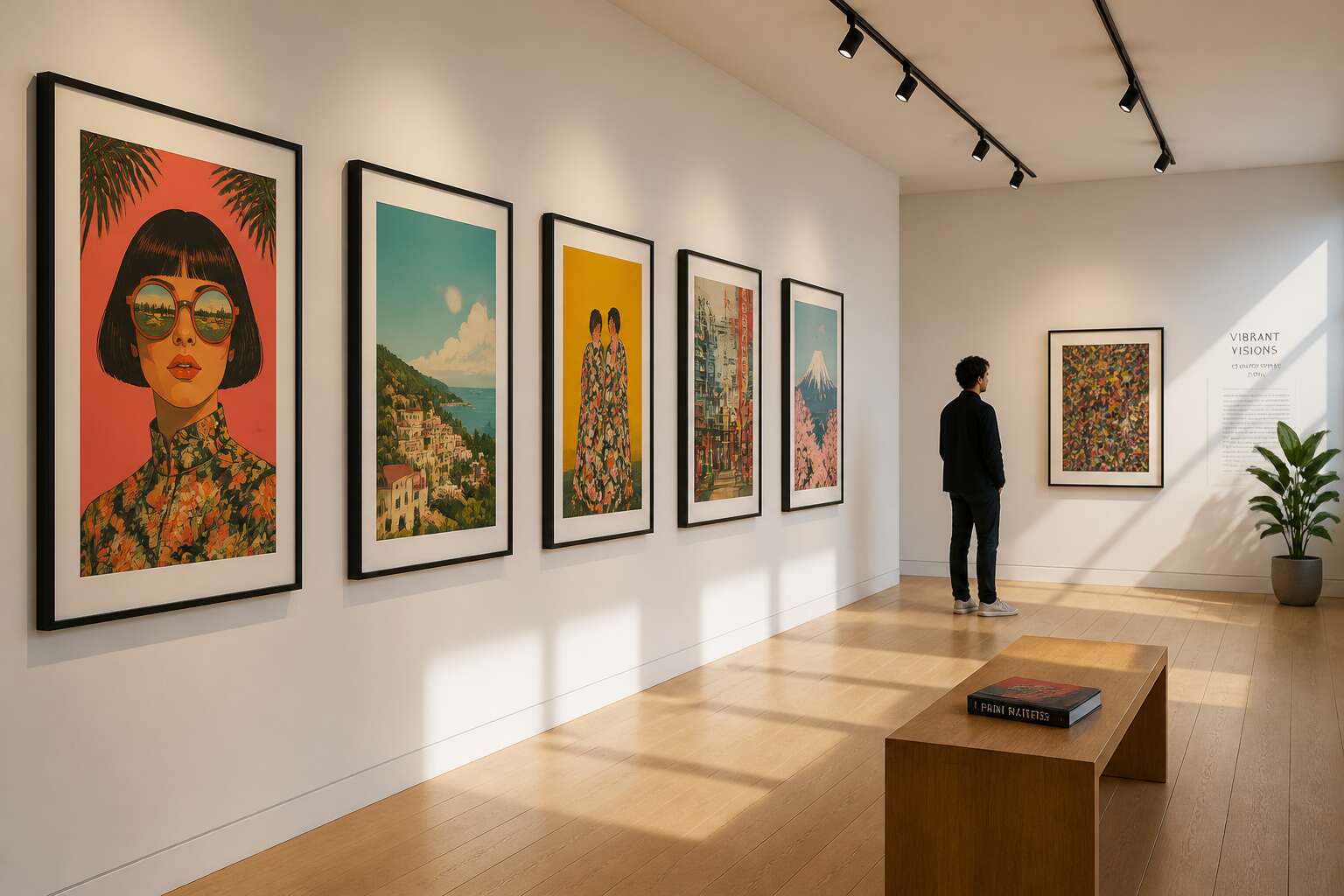
The average visitor gives a single artwork less than ten seconds of attention. That is the reality of a contemporary art print exhibition. A thoughtful layout changes this. I have seen collectors walk past a serigraph because the wall was too crowded. The flow must feel intent-driven.
Start with the entrance threshold. The first piece should anchor the viewer’s gaze without blocking the pathway. Then, use visibility to your advantage. A long sightline towards a back wall invites movement. But spacing matters just as much! For a South African audience, the arrangement must accommodate crowding without feeling vacant.
Consider grouping prints by visual pacing or tonal weight. For example:
- Group dark, introspective works in one alcove.
- Place vibrant, large-scale editions along the main traffic line.
- Reserve intimate pieces for smaller rooms.
This curation makes the art print exhibition feel cohesive. Every turn offers a new perspective. That is maximum impact.
“`
Lighting Strategies to Highlight Detail
Light rarely gets a second thought until a print fails. I once entered a gallery where a linocut looked washed out, destroyed by a ceiling array meant for paintings. The art print exhibition demands controlled illumination, not drama.
Consider these strategies for preserving detail:
- Use narrow-beam spots to isolate ink density.
- Set ultraviolet filters to prevent fading.
- Test with a print mounted on the actual wall.
Raking light reveals every line’s depth. Ambient illumination maintains the eye’s adaptation. Without this balance, the print loses its clarity.
Framing and Matting Choices
A frame is not a border, it is a custody agreement. In an art print exhibition, the wrong matting can mute a print’s voice before anyone hears it. I have watched collectors walk past a stunning etching because the frame fought the paper. Choose moulding that recedes, not roars.
Conservation-grade mat board is non-negotiable, yet its colour matters. White, off-white, or deep charcoal alter the print’s temperature. For a monochrome piece, a double mat adds depth without distraction. Consider the print’s provenance; a hand-torn deckle edge deserves a window that shows it. Practical checks include:
- Verify rabbet depth for the print stack.
- Use UV-filtering glass regardless of light plan.
- Hinge with archival tape, never glue.
The scale of the frame sets the rhythm. Oversized frames create mausoleums; undersized frames create claustrophobia. In a group display, consistent mat widths unify the wall. The art print exhibition ends when the frame demands applause. Make it a silent partner.
Thematic Grouping of Works
Thematic grouping defines an art print exhibition. I once curated a small show where three urban sketches, each depicting the same corner of downtown Johannesburg, became the talk of the evening. The prints shared a location but diverged in mood. That contrast created memory.
Group works by a unifying principle, such as a repeated object, a season, or a social critique. Do not rely on artist names alone. The visitor seeks a story. Practical criteria include:
- Shared compositional structure
- Contrast of technique
- Progression of scale
Keep clusters between three and five works. Leave generous empty wall between clusters. The exhibition then feels coherent, not scattered. That is the value of thoughtful grouping.
Interactive Zones for Education
Seventy percent of visitors spend less than twenty seconds before an artwork. A static display loses them. In a South African art print exhibition, interactive zones change this equation by turning observation into participation.
These zones might hold magnifying loupes to inspect paper grain, or drawers of rejected proofs that show the artist’s corrections. Education becomes tactile. Establish a sequence for the visitor.
- Touch a sample print to feel the ink depth.
- Read an artist’s note written in their own hand.
- Try a stamping station that mimics a reduction linocut.
Each step builds understanding without a lecture. The gallery becomes a workshop where the act of learning is inseparable from the act of seeing.
Strategic Pricing and Sales Tactics
Determining Value Based on Edition Size
At an art print exhibition, I overheard a visitor ask why two identical prints differed by a thousand rand. The answer is the edition size! Collectors notice that number immediately. Small editions signal scarcity. A run of ten lets each print carry the artist’s reputation. A run of one hundred makes the image more attainable, yet the market value thins accordingly.
Smart galleries price the first tier of an edition to reward early conviction, then raise the price as the run diminishes. A common tactic involves:
– a small artist’s proof set at a premium
– a mid-tier edition held at a steady price
– a final third discounted to move inventory
This structure respects the collector’s intelligence. At an art print exhibition, the price is a negotiation between rarity and desire, and the wise buyer knows which number to watch.
Bundle Offers and Package Deals
Three prints for the price of two makes accountants wince and collectors grin. At an art print exhibition, the bundle remains a retail staple. The buyer stops asking which single piece deserves wall space and starts asking which trio makes the lounge look intentional.
Galleries in Johannesburg handle this with precision. A typical package pairs a bold statement piece with two quieter studies. The statement piece carries the value, the studies arrive as sweeteners.
- The starter wall: one large print, two small ones, a single discounted price.
- The series capture: all three editions from one run, boxed together.
- The collector’s gamble: one mystery print plus a guaranteed favourite.
I have watched savvy buyers circle these bundles three times before committing. The rand saved on the bundle often covers the framing. At an art print exhibition, the bundle exists to move volume while making the collector feel like a strategist!
Exclusive Early Access for VIPs
Nothing makes a collector commit faster than the suspicion that someone else might get there first. Exclusive early access for VIPs turns an art print exhibition into a velvet rope experience, where the rope is imaginary but the urgency is real.
The mechanics are simple. A select list receives the catalogue forty eight hours before the doors open. They walk the aisles without the crowd. They make decisions based on desire, not competition. The gallery wins because serious buyers commit before the indecisive public arrives. The VIP wins because they feel like an insider, even though everyone with an email address knows about it.
Pricing follows a quiet logic. The early access preview at the art print exhibition carries no discount. The premium is the illusion of priority. For a certain kind of collector, that illusion is worth more than any markdown.
Using Scarcity to Drive Demand
Scarcity without structure creates chaos! An art print exhibition that sells randomly loses potential revenue and gives collectors no reason to decide today. The disciplined approach is tiered escalation. Price increases as inventory thins, announced in advance, so hesitation carries a visible cost.
One Johannesburg gallery tested this. They set three price points:
- Opening week: R1,200 per print
- After fifty percent sold: R1,800
- Final ten pieces: R2,400
Collectors who waited paid the difference. Not one print remained unsold. The strategy worked because the rules were transparent. Nobody felt tricked, they felt warned. Scarcity drove demand without desperation. The gallery became a market that rewarded attention.
After-Sale Engagement and Follow-Up
Once a collector purchases, many galleries forget them. That is a mistake. Your art print exhibition needs a follow-up rhythm that turns one sale into a relationship. Send a handwritten note within a week. Share behind the scenes images of the printing process. Ask for feedback on the installation.
For repeat engagement, track what each person bought. When you host another event, mention their specific piece. That recognition matters. One gallery I worked with sent a six month check in email. The response rate surprised them.
Use post sale surveys to learn what motivated the purchase. That data shapes your next pricing strategy. A buyer who feels seen will return. Your art print exhibition becomes a community, not a transaction.
Commission Structures for Artists
Many South African galleries use a 50% commission, but that number is negotiable. In my experience, the agreed commission structure for your art print exhibition directly sets your baseline price. If the gallery takes half, your print price must double your required take home. If you sell directly via your website, you keep the full margin, which allows for a lower retail price.
Consider these structures when negotiating your next art print exhibition.
- Flat percentage: straightforward, but it ignores the cost of larger editions.
- Tiered commission: higher priced prints carry a lower percentage, rewarding volume.
- Buyout: the gallery buys the prints outright, giving you immediate cash flow and transferring risk.
Pricing a print is a calculation of production, time, and commission. When you know the split, you can set a price that feels honest to the collector and sustainable for you. The numbers must work before the opening night.
Spreading the Word Through Multi-Channel Marketing
Building Buzz on Social Media
Seventy percent of visitors to a recent Johannesburg gallery opening arrived after seeing a single social media post. That is the power of multi-channel marketing for any art print exhibition. Email newsletters, WhatsApp statuses, and targeted ads each contribute to the broader narrative.
The most effective campaigns build momentum over weeks. A teaser video on Instagram Reels, a collector’s testimonial on Facebook, and a behind-the-scenes story on TikTok create anticipation without overwhelming the audience. Each platform reaches a different segment of the community.
- Instagram for visual discovery
- WhatsApp for direct conversation
- LinkedIn for corporate buyers
- Pinterest for interior designers
The result is a set of touchpoints that guides potential collectors toward opening night. When these channels work in harmony, the art print exhibition becomes a shared experience across the city.
Email Invitations That Convert
Email invitations require a different strategy than social posts. A feed scrolls past; an inbox demands attention. For an art print exhibition, the invitation email should arrive on a Tuesday morning, not a Friday afternoon. Earlier in the week, collectors are making decisions. Later, they are closing their laptops.
The elements that convert:
- A subject line naming one artist or one print
- A preview image that matches the display planned for opening night
- A clear RSVP deadline set ten days out
Write the email as a personal note. Address the collector by name. Mention their last acquisition if you have that record. Short paragraphs, one idea each. The art print exhibition depends on the opening paragraph, so state the date, the venue, and the reason to attend within the first three lines.
Partnerships with Interior Designers
An art print exhibition lives or dies by the rooms it enters. Interior designers curate those rooms. They choose what hangs above a client’s sofa, what greets guests in a hallway. Partnering with designers means your prints appear in real homes, not only on a gallery wall. The designer becomes a channel, their studio a second venue.
Offer designers a preview evening before the public opening. Give them first pick of editions for their clients. They bring their own networks, their own commission structures.
- Designers who love a print will mention it to every client
- Their projects become walking advertisements for the art print exhibition
- A single high-profile installation can drive more enquiries than a week of social posts
Track which designers send clients through your doors. Build relationships around those names.
Press Releases and Local Media
Press releases remain the steady foundation of any art print exhibition campaign. A well written release sent to local newspapers and community radio stations reaches eyes that never scroll a hashtag. In South Africa, regional press still holds trust. That trust translates into foot traffic!
Tie the art print exhibition to a place and a moment. Editors want concrete details, not vague promises. Provide high resolution images. Offer interview slots with curators. Make their job simple.
Multi-channel means more than one message. The same event appears across print, radio, and digital platforms. Each mention reinforces the others. A morning radio slot can drive afternoon visits. A newspaper feature can prompt weekend trips.
Here is what a coordinated local press push often includes:
- A tailored press release sent to three local outlets.
- A follow up phone call two days before the opening.
- Journalists invited to a private preview.
- Published coverage shared across your own channels.
The cumulative effect turns a single event into a talking point across the community!
Influencer Previews and Art Bloggers
Influencers and art bloggers build authority through authenticity, not editorial mandate. When an influencer stands before your art print exhibition and shares that moment with followers, the audience receives it as a personal recommendation. This bypasses skepticism in a way that a paid ad never can.
A curated preview for bloggers should feel exclusive. Offer a private walkthrough with the curator. Provide photography angles that highlight the print quality. Let them inspect the paper and edition numbers. Their content becomes a story about craft, not just an announcement.
- Invite five to ten niche art or lifestyle bloggers
- Schedule the preview two days before public opening
- Share their posts across your own channels
This approach turns an art print exhibition into a living conversation, one that spreads through trusted voices rather than paid placements.
Paid Advertising Best Practices
Every rand spent on paid advertising must earn its place. A retargeting campaign on Meta recaptures visitors who left your art print exhibition page halfway through. Google Search catches the person typing ‘art print exhibition near me’. Each channel demands its own message. Search ads require specificity. Display ads need strong visuals. Social video requires an early hook.
Geo-fencing around gallery districts delivers location-based ads to collectors already walking past your venue. This tactic works well in Johannesburg and Cape Town. Match budget allocation to audience habits. Track conversions with UTM parameters and pixel data.
Set frequency caps to prevent ad fatigue. Test two creatives per platform weekly. Kill underperformers without sentiment.
Crafting an Unforgettable Visitor Journey
Welcome and Orientation Areas
At the threshold of any art print exhibition, the first sixty seconds shape every subsequent impression. Visitor studies show that over half of attendees decide their engagement level before reaching the second wall. The welcome area must orient visitors efficiently. An effective orientation space uses sightlines, not signs alone, to draw people deeper into the narrative.
Our Cape Town venue places a tactile map on a slanted plinth, allowing guests to trace their route with a fingertip. A low bench offers a pause for those who arrive uncertain. The floor transition from carpet to timber, and the single spotlight on the reception desk, direct the visitor toward the first gallery. Patience becomes a practical requirement here, and the entry zone gives each person the time to adjust.
Curator Talks and Artist Q&A Sessions
A successful curator talk is part performance, part confession. At the recent art print exhibition in Johannesburg, over two hundred guests stayed forty minutes past the scheduled end of a Q&A session, an outcome no printed programme could have predicted. That lingering tells a story. People do not remain for wall text. They remain for voices.
Good curator talks extend the value of an art print exhibition. Once the artist steps off the podium, the conversation shifts. Someone asks about proofing. Someone else asks about the edition that sold out. A firm moderator ensures the session becomes neither a lecture nor a free-for-all.
A useful session covers:
- The decisions behind each print’s scale
- The order in which works were created
- The particular anxieties of releasing a limited run
These are not secrets. They are context. The evening ends, but the stories from the floor stay in the room!
Live Printing Demonstrations
At a live printing demonstration, the press becomes a performer. The artist pulls the first proof and the room goes silent. I have watched that silence turn an art print exhibition into a personal memory. Visitors lean in to see ink settle, paper shift, and colours emerge in real time.
For those who stay, several things become clear:
- The exact pressure needed for a perfect impression
- Why certain papers absorb ink differently
- How edition numbers get assigned on the spot
These demonstrations break the glass between maker and viewer. The hum of the roller, the smell of fresh print, the artist’s steady hands. A single pull of the lever can anchor an entire art print exhibition in a visitor’s mind.
Digital Catalogs and Audio Guides
Visitors spend an average of eight seconds per artwork, a figure that should alarm any curator. Digital catalogs and audio guides can stretch those seconds into minutes of thoughtful engagement. At an art print exhibition, a well spoken guide reveals the quiet drama of a lithograph while your eyes follow the pressure marks. The catalog lets guests take the show home without acquiring a frame.
Practical visitors appreciate structure. These audio guide stops serve that purpose:
1. The earliest proof, explaining paper grain.
2. A misprinted edition, revealing process.
3. The final numbered print, comparing state changes.
These tools do not replace conversation. They grant permission to pause. A visitor who lingers over one plate, guided by a voice in their ear, becomes the sort of person who returns.
Post-Exhibition Survey and Community Building
The final day of an art print exhibition marks the start of a longer relationship. A post-exhibition survey captures visitor impressions while they remain vivid. I have found that asking about navigation, lighting, and the moments that felt transformative yields honest answers. Responses reveal which prints prompted conversation and which spaces fell flat. Community building follows this data, not the other way around.
Instead of a generic email blast, invite attendees to a private online group. Share behind-the-scenes content, artist interviews, and early notice of the next art print exhibition. Regular members become repeat visitors who bring friends.
A simple follow-up structure works well:
- Send the survey within 48 hours.
- Share aggregate results with participants.
- Announce the next event exclusively to the group.
This sequence turns a single visit into a sustained connection. The collected data shapes future layouts while the community sustains interest between shows. When the next art print exhibition opens, these visitors arrive prepared to engage deeply.


0 Comments