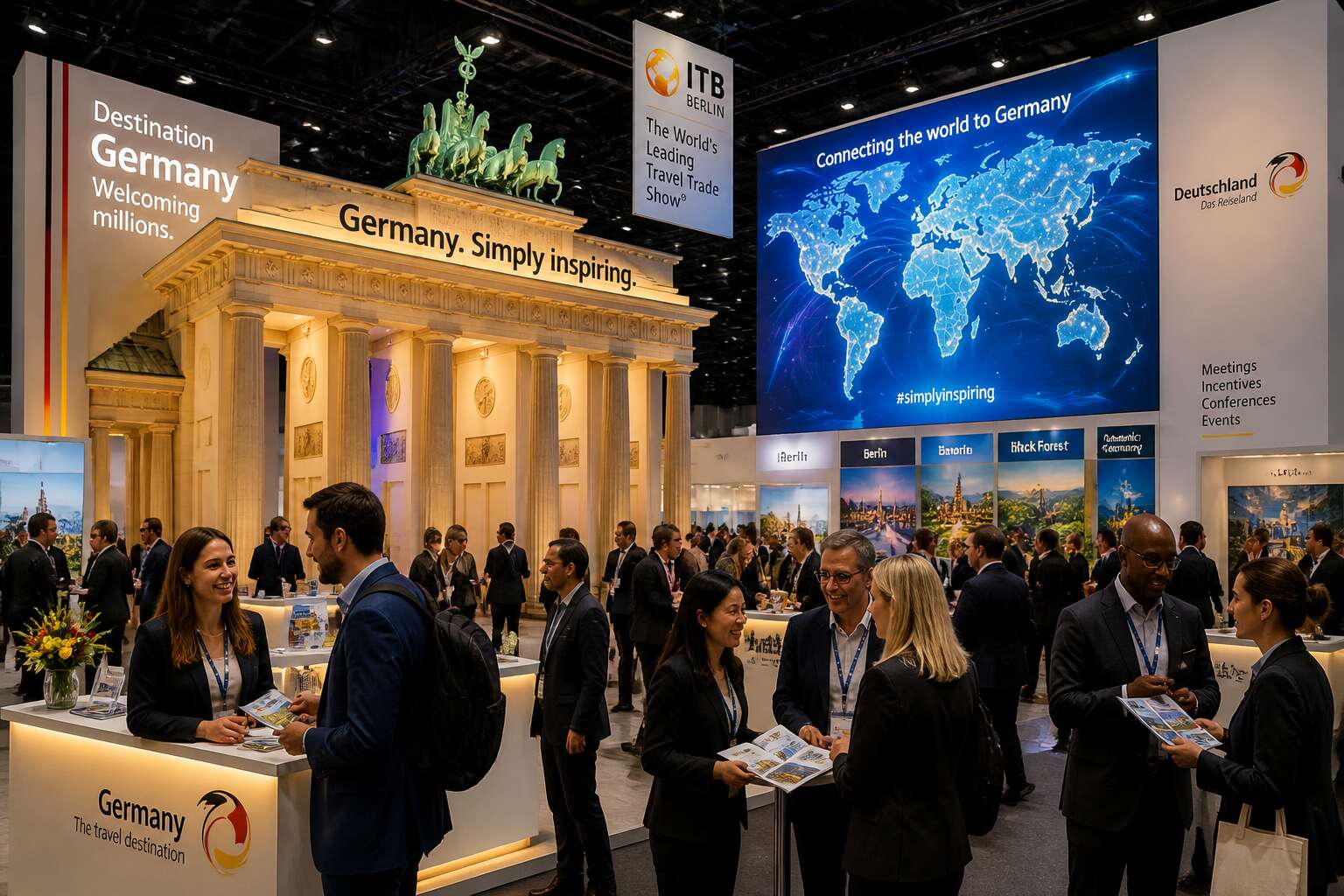
Why Germany Is a Hub for International Travel Shows
The Economic Powerhouse Behind German Trade Fairs
Germany hosts more than 150 international trade fairs annually, a number that explains its central role in global travel. The exhibition industry itself underpins this activity, generating billions in revenue and supporting thousands of jobs. Purpose built halls, integrated logistics, and a hospitality network operate with reliable efficiency across the country.
Consider the scale of investment! Messe Frankfurt alone allocates substantial capital to expand its campus. This spending reflects a broader pattern where public and private entities combine to maintain Europe’s most advanced fairgrounds. The result is a smooth experience for exhibitors and visitors.
When you attend a tourism exhibition germany, you enter this system. Spending flows into hotels, transport, and local businesses, proving that trade fairs function as economic contributors rather than isolated events.
Major Exhibition Cities: Berlin, Munich, and Frankfurt
Berlin draws event organisers with its mix of history and reinvention, while Munich offers a backdrop of engineering excellence and Bavarian hospitality. Frankfurt, meanwhile, functions as a gateway for global delegates thanks to its airport and central rail links. Each city shapes its own atmosphere, yet all share the infrastructure that makes a tourism exhibition germany run flawlessly.
Consider what these venues provide:
- Flexible hall layouts for immersive travel displays
- Direct transport connections from international hubs
- Accommodation clusters within walking distance
This trio of destinations gives planners a genuine choice. Berlin excites with cultural edge, Munich reassures with order, and Frankfurt delivers speed. I have seen exhibitors adapt their stands to each city’s personality, which keeps every edition fresh. That adaptability is why Germany remains the default meeting point for travel professionals across the globe.
What Makes German Travel Expos Stand Out Globally
Once you have wandered through a South African travel expo, the scale of a tourism exhibition germany can feel almost absurd. More than 150 international travel shows touch down on German soil every year, and each one hums with a precision that borders on obsessive. What sets these gatherings apart is not the sheer size, though that helps. It is the stubborn refusal to leave anything to chance.
German organisers test every detail, from digital check-in systems to multilingual signage. They also know how to keep delegates fed, caffeinated, and moving between sessions without chaos. That reliability lets exhibitors focus on storytelling instead of firefighting.
A few recurring strengths appear across the country’s top events:
– Live data dashboards that show foot traffic in real time
– Zero tolerance for slow Wi-Fi, even in basement halls
– Sustainability audits that shame other nations into action
Expect to leave with sore feet, a full notebook, and genuine respect for the machinery behind the magic.
Top Travel Trade Events to Put on Your Calendar
ITB Berlin: The World’s Largest Travel Trade Show
Each March, Berlin hosts ITB, the world’s largest travel trade show. This tourism exhibition germany gathers over 10,000 exhibitors and 100,000 trade visitors. For South African professionals, it provides direct access to decision makers worldwide. The floor buzzes with negotiations that set next season’s routes. I have watched startups leave with partnerships that transform their businesses. ITB’s matchmaking system stands out, allowing you to prebook meetings with buyers who fit your exact criteria. That single feature justifies the trip! The stages host sessions on sustainable travel and digital booking trends. Most attendees spend two days just covering the halls.
If you plan your visit, prioritize:
- Prebooked appointments
- Innovation pavilions
- Emerging destination pavilions
These elements deliver the highest return on your time. ITB remains the definitive meeting point for serious global tourism professionals.
IMEX Frankfurt: A Premier Platform for MICE Tourism
Frankfurt am Main turns into a gathering point for event planners each May when IMEX takes over the Messe. This tourism exhibition germany focuses exclusively on MICE, the world of meetings and incentives. Nearly 15,000 attendees scout venues, tech, and fresh ideas. A friend in the industry calls it speed dating for conference nerds, and she is not wrong.
The show floor mixes luxury resorts with functional meeting rooms. Speed networking sessions resemble controlled chaos. For South Africans, IMEX offers direct access to European buyers without the usual email ping pong.
- Hosted buyers with back to back appointments
- Live demos of hybrid event platforms
- Negotiations happening over pretzels
The few days at IMEX compress business into sharp, focused conversations. Every handshake has a purpose, even the one that ends with a business card.
COTAI Travel Expo: Emerging Markets in Germany
COTAI Travel Expo occupies a secondary hall at Leipzig’s fairgrounds. While ITB and IMEX attract global attention, this tourism exhibition germany serves buyers from emerging markets. Attendees come from Kazakhstan, Nigeria, Ukraine, and other overlooked regions. They arrive with specific procurement lists and actual budgets. Western sellers often underestimate these buyers, leaving space for prepared operators.
- Direct meetings with tour operators from 20 countries.
- A dedicated pavilion for Central Asian destinations.
- Sessions on cross border payment methods.
The expo runs twice a year. Hoteliers praise its manageable size. A delegate recently described the pace as practical, compact, and surprisingly busy.
F.re.e Munich: A Consumer-Focused Travel and Leisure Fair
F.re.e Munich flips the script. Where ITB and IMEX court industry whales, this tourism exhibition germany welcomes the weekend wanderer. It is the loud, cheerful cousin of trade fairs, where families plot holidays and alpenstock enthusiasts compare crampons. The show leans into Bavaria’s outdoorsy soul.
Expect packed stages with travel influencers, plus aisles of regional boards. A visitor can book a campsite in the morning and a river cruise by lunch. One oddity: the beer garden at the entrance, which sets a dangerously relaxed tone. Attendees often leave with flyers, a free tube of sunscreen, and a vague plan to climb a mountain. That is the charm.
Regional Exhibitions and Niche Travel Fairs
Somewhere between the beer halls and the Bundesliga, a quieter layer of the tourism exhibition germany scene operates with serious purpose. These regional and niche events rarely court international press, yet they generate substantial revenue. Take CMT Stuttgart, a sprawling show for camping, motorhome, and active travel. It draws people who own three types of rain jacket.
- Caravan Salon Düsseldorf, the world’s largest fair for mobile travel.
- RDA in Cologne, a focused meeting place for group travel and coach tourism.
- TourNatur in Düsseldorf, a hiking fair for people who fold maps.
For South African travel professionals, these events offer a different lens on the tourism exhibition germany ecosystem. You skip the global press conferences and watch how regional operators build loyal audiences.
Essential Tips for Visitors and Exhibitors
How to Register and Secure Your Entrance Badge
Your entrance badge grants entry to every hall at a tourism exhibition germany. Register early, as on site fees rise by forty percent. The official portal accepts credit cards, PayPal, and bank transfers from South African banks.
Exhibitors must prepare a dossier before submitting any payment. Required documents typically include:
- Certified trade licence copy
- Tax clearance certificate from your local revenue service
- Product liability insurance with valid dates
After payment clears, you receive a confirmation code via email. Save it on your phone, because printing it wastes time. At the venue, present that code with your passport at the registration counter. Your badge arrives with a barcode linked to your profile. Certain seminars require an extra ticket, which you can collect from the information desk after badge pickup. The entire process generally takes under three business days once your payment is confirmed.
Navigating the Exhibition Halls Efficiently
German trade halls cover more ground than most visitors expect. At a tourism exhibition germany, the floor plan is your first tool. Download the official app and mark the halls you must visit. The big destinations cluster near the main aisles, while regional pavilions tuck into the corners.
Exhibitors face a different puzzle. Stand staff need a rotation schedule. No one stays sharp after four hours of small talk. Plan breaks in shifts and send someone to scout the competition with a specific question in mind.
A simple rule saves time for everyone:
- Confirm meeting times with your own calendar, not the organiser’s.
- Carry water; the air conditioning dries you out faster than you expect.
- Wear broken-in shoes.
The gaps between seminars at a tourism exhibition germany are shorter than they look. Ten minutes is enough to move one hall over if you walk with purpose. In my experience, the side entrances always move faster than the main doors. Leave the long conversations for the evening events.
Networking Strategies for Meetings and Partner Events
At a tourism exhibition germany, the most productive exchanges often take place in the aisles and at partner events. Visitors who treat networking as an afterthought miss the point. Exhibitors know that a partner meeting is where tentative conversations turn into signed agreements.
Meetings at these fairs are short by design. The best attendees arrive with a clear intention and a flexible agenda. They listen more than they talk. They also respect the other person’s schedule, which builds trust faster than any brochure.
- Follow up within 24 hours, not next week.
- Ask a specific question about their destination or product.
- Introduce one useful contact from your own network.
The tourism exhibition germany rewards those who show up prepared and leave room for spontaneity. Partner events are where the exhibitor’s personality comes through, and the visitor’s genuine interest becomes memorable.
Accommodation and Travel Logistics During Peak Dates
Hotel prices in Berlin triple during ITB week. That is not hyperbole. It is the arithmetic of supply and demand colliding with 100,000 attendees. The savvy visitor books accommodation eight months out, or they face a commute from Brandenburg. The tourism exhibition germany operates on a citywide scale, and last minute bookings punish the unprepared.
Your travel window matters more than your hotel choice. Arriving the morning of your first meeting is a gamble. Early morning trains and airport queues consume the patience you need for exhibition aisles. Build in a buffer day before the fair and another after it. This protects you from delays and gives you time to decompress.
Public transport remains the only sane option. Rental cars sit in traffic, and parking costs resemble a second hotel bill. The U-Bahn and S-Bahn networks connect directly to the fairgrounds in every major German city. Download the transit app before you land.
– Check if your hotel offers a discounted fair ticket or transport pass
– Confirm your exhibition hall entry point before you navigate the grounds
– Keep your passport and registration confirmation in your day bag
The logistics of a tourism exhibition germany demand the same precision you bring to your business meetings. Treat travel planning as part of your professional strategy, not an afterthought. The exhibitors who shine are the ones who arrive rested, and the visitors who close deals are the ones who never worry about missing the last train home. Book early, pack light, and move with the city’s rhythm rather than against it.
Leveraging German Exhibitions for Business Growth
Showcasing Your Brand to a Global Audience
The true value of a tourism exhibition germany extends far beyond the sheer spectacle of the halls. For a business, it is a rare opportunity to compress months of sales conversations into a single week. The buyers walking these floors are not casual browsers; they are procurement managers and tour operators with active budgets. Your presence signals that your operation is serious about the European market.
This is where your brand moves from a digital entity to a tangible experience. A well-designed stand becomes a sanctuary where potential partners can feel the texture of your offering. Consider the specific profiles you will meet:
– Destination management companies scouting for unique African experiences.
– Corporate event planners seeking unconventional venues.
– Inbound operators looking for reliable ground handlers.
Each interaction is a data point. You learn the language of the buyer, their price sensitivity, and their seasonal rhythms. This intelligence is the catalyst for product adaptation. A tourism exhibition germany is not a passive showcase; it is a pressure test for your service. The feedback is immediate and unfiltered, providing clarity that no online meeting can replicate. You leave with a refined pitch and a list of qualified leads who have seen your work in a professional context.
B2B Matchmaking and Lead Generation Opportunities
Consider the mathematics of a trade fair floor. A single conversation at a tourism exhibition germany can replace a dozen emails and a month of scheduling conflicts. The return on investment is measured not in foot traffic, but in the precision of the meetings you secure. B2B matchmaking platforms at these events operate like a social concierge for the industry. They pair you with vetted buyers based on your specific product type and target demographics.
The lead generation process at a tourism exhibition germany is a study in efficiency. You are not collecting business cards; you are collecting mandates. The most productive exchanges occur in the structured appointments arranged weeks in advance, but the serendipitous encounters at the coffee stations often yield surprising results.
My own experience at these halls has taught me that the quality of the interaction is directly proportional to the preparation. The buyers who schedule meetings are on a mission. They have a list of products they need to source and a limited window to find them. Your window to impress is often less than twenty minutes.
– Pre-scheduled appointments with procurement managers from European tour operators.
– Spontaneous introductions at regional pavilions that lead to niche distribution deals.
– Follow-up meetings with government tourism boards seeking new partners.
The data you gather is granular. You learn which package resonates with a German audience and which price point makes them pause. This is not abstract marketing; it is direct market research. The leads generated here are qualified because they have already invested their time and travel budget to be present. They are actively seeking new supply. The conversations are intentional, and the follow-up is a natural next step rather than a cold call. This is where the groundwork for long-term partnerships is laid, not in the quiet of an office, but in the controlled chaos of a bustling hall.
Understanding German Business Etiquette at Trade Shows
The German handshake is not a formality; it is a contract. At a tourism exhibition germany, you will be assessed within the first ten seconds, often before a single word about your product is spoken. Your punctuality, your posture, and your preparedness are all part of the evaluation. Arriving late to a scheduled appointment is not just rude, it is a disqualifier. The German business culture values structure over spontaneity, and your ability to respect that structure signals your reliability as a partner.
This emphasis on order extends to the conversation itself. You will not be interrupted, and you should not interrupt in return. The discourse is direct, with a focus on hard facts and concrete deliverables. Small talk is minimal, but it is not absent. A brief, polite inquiry about their journey to the fair suffices before you pivot to the business at hand. The buyers here are not looking for a charismatic pitch; they are looking for verifiable proof that your product can solve their logistical challenges.
– Maintain direct eye contact during introductions.
– Present your business card with both hands, and take time to read theirs.
– Address individuals by their surname and title until invited to use first names.
The dress code at these events leans conservative, even for a tourism exhibition germany. Opt for business attire that is understated and tailored. You are selling trust, and trust in this market is communicated through a lack of visual clutter. The negotiation style is methodical. You will be quoted a price, and the expectation is that your rebuttal is backed by data, not emotion. If you have a better offer, present the spreadsheet. If you have a unique selling point, show the certification.
Watching the dynamics at the booths, one notices a clear pattern. The most effective exhibitors are not the loudest. They are the ones holding the quiet, focused meetings in the back corners of the hall. They understand that the deal is won through a shared respect for time and a clear articulation of mutual benefit. The German phrase “Der Ton macht die Musik,” meaning the tone makes the music, applies perfectly here. Your tone must be respectful, direct, and devoid of hyperbole. This approach turns a simple exchange of brochures into a foundational meeting for a long-term commercial relationship.
Post-Show Follow-Up and Long-Term Partnerships
Most exhibitors lose the deal within two weeks, not because the meeting went poorly, but because the follow-up was forgettable. At a tourism exhibition germany, the real work begins after the hall lights dim. The buyers you met are inundated with generic “great to meet you” emails. Standing out requires specificity. Reference the exact conversation, the challenge they mentioned, and how your solution addresses it. Timeliness matters. A response within 48 hours shows respect for their schedule. Long-term partnerships in this market are built on consistent, reliable communication. One follow-up is not enough. I have seen the best relationships develop through a scheduled cadence that adds value each time:
- Send a tailored proposal within two days.
- Share a relevant case study one week later.
- Schedule a call for the following month.
This methodical approach mirrors the culture of the event itself. The partnership grows because you treat the relationship with the same precision you brought to the exhibition floor.
Trends Shaping the Future of Travel Fairs in Germany
Digitalization and Hybrid Event Formats
At a tourism exhibition germany, the queue for a coffee machine snakes past a wall of screens. Those screens carry live negotiations from Seoul and São Paulo. Digitalization has moved from the periphery to the core of these gatherings. Hybrid event formats are not a pandemic relic. They are a permanent layer, offering flexible attendance for global players.
Key shifts include:
- AI driven lead generation that prioritizes relevant contacts
- Virtual showrooms accessible year round
- Simultaneous translation for multilingual sessions
For South African travel companies, this means lower entry barriers. You can inspect a destination’s booth remotely, then arrange a focused meeting at the next physical edition. The conventional exhibition still matters, but its boundaries have dissolved.
Sustainability Practices in Exhibition Management
Germany’s travel fairs are recasting themselves around regenerative principles. Exhibition halls now track their carbon footprint per exhibitor, and organisers are adopting reusable stand systems. This shift responds to visitor expectations, particularly from younger travellers who scrutinise a fair’s environmental record.
Several sustainability measures are becoming standard:
- Modular construction materials that are repurposed across multiple editions
- Digital event guides replacing printed programmes
- Local food sourcing for catering areas
Beyond green logistics, the future of travel fairs points toward tighter, more purposeful gatherings. I have watched smaller regional showcases develop into fixtures beside the international events. For South African operators, a tourism exhibition germany now offers a space to test new partnerships while aligning with global sustainability standards.
The Rise of Personalized and Experience-Driven Booths
At this year’s tourism exhibition germany, the busiest booths were not the largest. I watched a modest stand draw a steady crowd, not because of its size, but because it recreated a dawn chorus from the Okavango Delta. Tiny speakers, soft moss, damp air. Visitors stood still, listening.
Personalization drives booth design. Exhibitors analyse visitor data before the show, then tailor displays to specific buyer interests. Instead of a generic stand, they build an experience around one narrative. This generates deeper conversations and higher quality leads.
Consider what works:
- Live virtual tours with local guides
- Interactive maps that adjust to preferences
- Immersive tasting stations with regional produce
For South African operators, this means investing in storytelling, not square footage. A powerful booth does not shout; it invites you to stay!


0 Comments