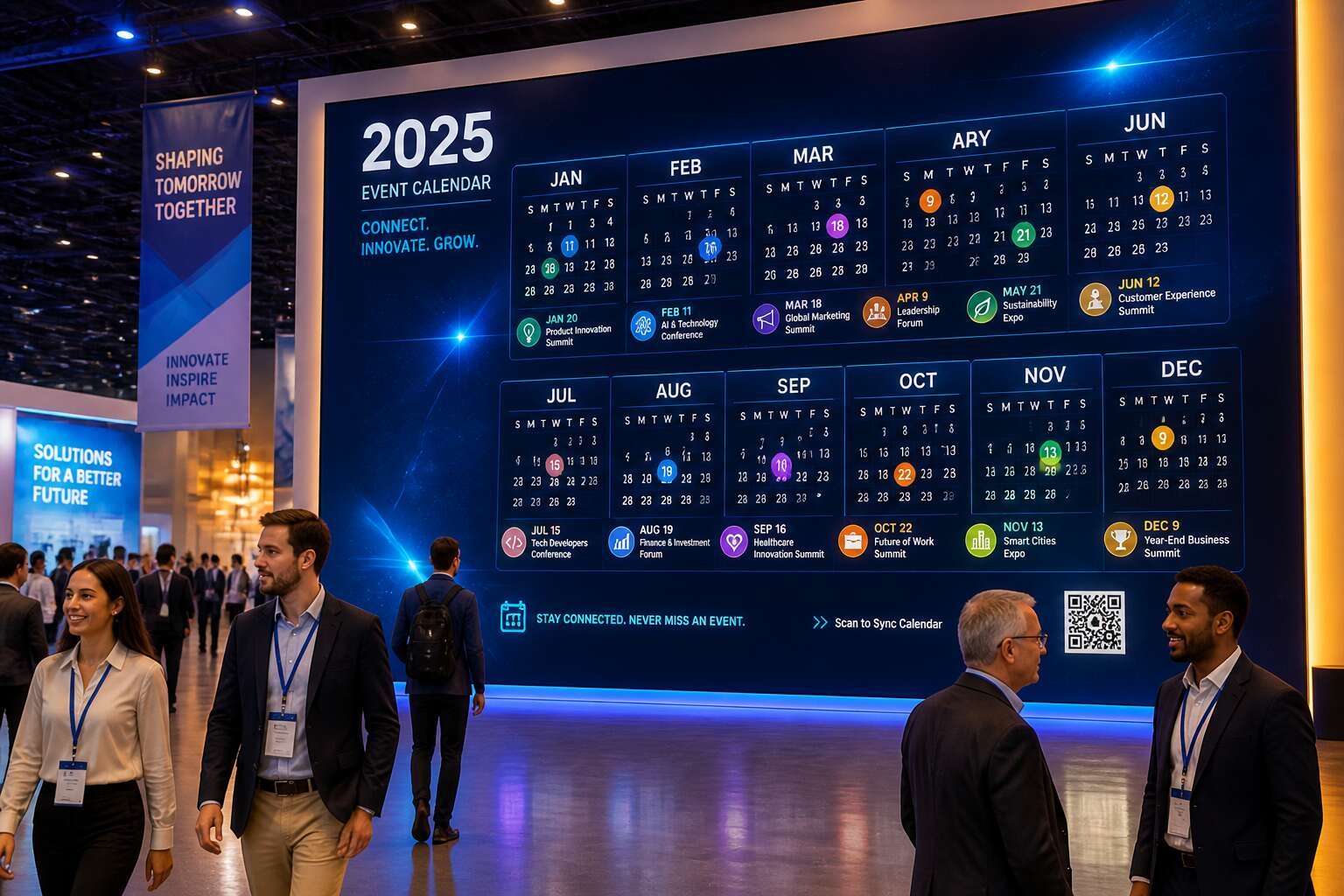
Major International Trade Shows and Expos in 2025
Technology and Innovation Fairs
Planning around technology and innovation fairs demands early commitment. The exhibition 2025 dates for major expos cluster in the first half of the year. CES opens January 7 in Las Vegas, showcasing AI hardware, automotive tech, and consumer devices. MWC Barcelona follows in early March, where connectivity and 5G take centre stage. Hannover Messe lands in late March, dedicated to industrial automation and smart manufacturing. I have watched teams scramble for last minute passes. Don’t be one of them.
Beyond the big three, VivaTech in Paris and Web Summit in Lisbon attract founders, investors, and researchers. Each fair draws a distinct crowd, and the energy shifts from week to week. Many African startups now travel north to exhibit.
- CES 2025: January 7 to 10, Las Vegas
- MWC Barcelona: March 3 to 6
- Hannover Messe: March 31 to April 4
Your calendar fills fast around these weeks. The exhibition 2025 dates are fixed, and budgets follow.
Automotive and Mobility Exhibitions
Traditional showrooms have lost their pull, yet exhibition floors remain crowded. For anyone tracking exhibition 2025 dates, the automotive and mobility circuit reveals where the industry is heading. Three events dominate this year’s calendar: Auto Shanghai, IAA Mobility in Munich, and the Paris Motor Show.
- Auto Shanghai: April 23 to May 2, China’s largest new-energy vehicle showcase.
- IAA Mobility: September 9 to 14 in Munich, with test drives and battery technology.
- Paris Motor Show: October 14 to 20, focusing on compact EVs and charging infrastructure.
These venues give South African parts suppliers a direct line to global procurement managers. The dates are fixed, so early registration discounts are the only saving available. Block the weeks now, because every other exporter is doing the same.
Healthcare and Pharmaceutical Conferences
The healthcare and pharmaceutical conferences in 2025 carry a quieter weight than auto halls. For South African suppliers of medical devices or active ingredients, the exhibition 2025 dates dictate production timelines. Arab Health opens January 27 to 30 in Dubai, a passage to Middle Eastern procurement desks. MEDICA in Düsseldorf runs November 17 to 20, where lab diagnostics and imaging specialists survey new tools. CPHI Worldwide assembles in Frankfurt from October 28 to 30, a raw market for pharma ingredients and contract manufacturing.
- Arab Health: Jan 27-30, Dubai
- CPHI Worldwide: Oct 28-30, Frankfurt
- MEDICA: Nov 17-20, Düsseldorf
These dates are fixed. Late registration forfeits booth position. The conversations here focus on regulatory clearance, cold chain integrity, and digital trials. The exhibition 2025 dates remain your only reliable marker in a shifting calendar.
Sustainability and Green Energy Events
Green energy events in 2025 carry their own urgency. For South African solar installers, the exhibition 2025 dates decide when stock must land in Durban or Johannesburg ports. The Africa Energy Indaba runs March 4 to 6 in Cape Town, drawing utility buyers and municipal procurement officers from across the continent. The Solar & Storage Show Africa follows on March 25 to 27 in Johannesburg, where inverters and lithium cells dominate the aisles.
- Africa Energy Indaba: March 4 to 6, Cape Town
- Solar & Storage Show Africa: March 25 to 27, Johannesburg
- Intersolar Europe: June 25 to 27, Munich
European halls matter too. Intersolar Europe opens June 25 to 27 in Munich, a venue for module makers and hydrogen startups. These exhibition 2025 dates are fixed, and I have seen late registrants lose their booth positions. Conversations at these shows turn on grid capacity and tariff structures.
Regional Exhibition Highlights Across the Globe
North American Trade Shows and Conventions
The North American circuit carries its own gravity for planners seeking exhibition 2025 dates across diverse industries. Chicago’s food service gatherings and Orlando’s hospitality summits draw thousands of professionals each season. These events operate as living marketplaces where suppliers and buyers negotiate directly.
Attendance patterns shift from year to year. Some conventions have expanded their floors while others tightened their focus to niche audiences. For South African exporters, the key is matching the right show with the right product category. The major venues in Las Vegas, New York, and Dallas remain anchors for international participation.
A useful approach when comparing schedules:
- Verify registration deadlines for international delegates
- Check whether the venue offers translation services
- Confirm booth allocation timelines for first time exhibitors
Those logistics often determine success more than the exhibition 2025 dates themselves. Getting them right means the difference between a wasted flight and a fruitful week of meetings.
European Industry Expos and B2B Events
European industry expos attract more than three million professional visitors each year, yet South African exporters often overlook their potential. Major B2B gatherings in Germany and Italy align conveniently with southern hemisphere seasons, making travel worthwhile.
At events like Hannover Messe and Milan’s trade fairs, I have seen procurement managers negotiate directly on the floor. Halls fill with components, machinery, and finished goods. Many shows now feature dedicated African business lounges.
- Hannover Messe covers industrial automation
- Milan’s Expo focuses on design and furniture
- Paris hosts packaging and logistics expos
European fairs remain essential for manufacturers. Matching your product line to the right B2B event matters more than chasing the latest exhibition 2025 dates.
Asia-Pacific Exhibitions and Marketplaces
Asia-Pacific markets operate on a rhythm that rewards early planning. The Canton Fair in Guangzhou remains the largest trade gathering on the continent. Singapore’s Marina Bay Sands hosts specialised procurement events that connect regional suppliers with global retailers. Bangkok and Ho Chi Minh City have become serious alternatives for textile and food processing machinery.
What distinguishes this region is the speed of deal-making. I have watched buyers from Melbourne and Manila finalise contracts on the floor. The landscape breaks into clear segments:
- China dominates scale with comprehensive sourcing fairs
- Japan focuses on precision components and robotics
- Southeast Asia specialises in consumer goods and food processing
For South African exporters, matching your product line to these segments matters more than tracking every exhibition 2025 dates announcement. Organisers in this region often confirm dates late in the previous year, so serious buyers secure arrangements well before announcements circulate.
Middle East and Africa Emerging Sectors
The global trade map has shifted. While legacy circuits remain essential, the most dynamic growth is happening in the Middle East and Africa. Gulf states are aggressively diversifying their economies, moving beyond hydrocarbons to establish knowledge hubs in logistics, fintech, and advanced manufacturing. This transformation is tangible at the massive venues in Dubai and Riyadh, where attendance in 2024 saw double digit growth. Here, the synergy between state investment and private enterprise is visible, creating a concentrated environment for deal flow.
For South African companies, these are more than just opportunities. They are a direct route to customers with an appetite for quality goods and services. African markets, from Lagos to Nairobi, are equally active, although their exhibitions serve a different purpose. They are platforms for infrastructure development, agricultural technology, and retail franchising. The energy transition fuels much of this demand, from solar installations to water management systems. I see this shift firsthand. The connections made in these halls often outlast the event itself, leading to partnerships that span years.
The following sectors are driving interest in these regions:
– Energy transition and storage solutions
– Water purification and waste management
– Banking, payments, and financial inclusion technology
Remember that specific exhibition 2025 dates for these regions are often confirmed with less lead time than European counterparts. Mark your calendar early and verify registrations, as space for high value sectors fills quickly.
How to Plan Your Exhibition Calendar for 2025
Choosing the Right Events for Your Industry
Roughly a third of exhibitors never track which events produce actual revenue. That is a costly oversight, and it explains why so many calendars fall apart by mid-year. I have watched South African businesses chase attendance numbers while ignoring the only metric that matters: fit.
Start with your industry’s buying rhythm. A textile manufacturer in Durban and a software firm in Cape Town will not thrive at the same shows. The exhibition 2025 dates that work for one sector will ruin another’s pipeline. Build a shortlist of events where your existing clients already gather, then verify each show’s past attendee profile. It takes a phone call or two. It beats guessing.
Weigh these factors before committing:
- Buyer concentration rather than raw visitor volume
- Regional travel expenses, from flights to freight
- Timing relative to your internal launch cycles
Then lock in your exhibition 2025 dates with clear objectives assigned to each. A calendar built on fit beats one built on habit!
Key Factors for Budgeting and Logistics
The exhibition 2025 dates are known, yet the actual cost of appearing at them remains a mystery for many South African businesses. I have watched budgets fracture on freight rates and accommodation prices long before the first stand is built. Without a precise logistics plan, those dates become obligations that drain resources.
Start by itemising every expense, from venue deposits to electrical connections. Then add the silent costs: staff travel, daily allowances, insurance, and the risk of delayed cargo. The exhibition 2025 dates you choose determine how those figures behave across the year.
- Request binding quotes from three freight forwarders
- Reserve hotels between six and eight months in advance
- Allocate fifteen percent of total budget as contingency
Only then can you approach the calendar with confidence. Logistics are not an afterthought; they are the foundation of any fair appearance.
Seasonal Considerations and Peak Seasons
Exhibition 2025 dates are not equal; some months carry a heavier burden than others. In South Africa, autumn and spring offer moderate temperatures and fewer conflicts with school holidays. Peak seasons cluster in March and September, when international buyers schedule visits. I have seen exhibitors lock in these dates early, only to face crowded venues and premium freight rates. Planning your calendar begins with understanding these rhythms.
- Early autumn bookings secure better stand positions.
- December dates clash with widespread annual leave.
- Industry cycles often outweigh weather patterns.
The dates you select will shift your entire budget timeline. Winter events in July typically draw local audiences but fewer international visitors. Weigh these trade-offs carefully.
Registration Deadlines and Early Bird Discounts
Registration deadlines for exhibition 2025 dates have a nasty habit of sneaking up on even the most organised marketers. Most event organisers release early bird pricing roughly eleven months before the show floor opens. If you blink in June, you are paying full freight by October. The trick is to map every deadline across your target exhibition 2025 dates before your competitors do. Here is what to track:
- Early bird cut-off dates, usually 180 days before opening day
- Last chance for discounted booth upgrades
- Final cancellation windows without penalty
Each date shifts your internal workflow. Missing the early bird raises your budget by 15% while doubling your blood pressure. The saving grace is that most exhibitors never read the fine print, so premium stands stay available well past the first cut-off. The early bird discount rarely survives contact with procrastination.
Networking and Lead Generation Opportunities
Roughly 40% of B2B leads still come from face-to-face interaction. That single statistic makes your exhibition 2025 dates the core of your annual lead generation strategy. The real work, however, lies in mapping each show’s networking rhythm before you book travel.
Every event carries its own flow:
- Pre-show matchmaking sessions that fill up three weeks ahead
- On-site lounge hours when decision makers actually linger
- The 48 hour post-show window where responses run hottest
Aligning your calendar around these moments produces measurable results. For South African teams managing multiple provinces, the value emerges when your schedule matches the moments your prospects are present.
Essential Resources for Tracking Exhibition Schedules
Official Event Websites and Organizers
Anyone who has ever chased a cancelled trade show knows the pain of arriving at an empty hall. The only reliable source for exhibition 2025 dates remains the official event website. Organizers publish updates, floor plans, and schedule shifts there first. Third-party aggregators often scrape old data or recycle outdated listings. A single check of the source saves you from a wasted trip to Johannesburg or Cape Town.
Reliable organizer pages tend to share certain characteristics:
- Direct contact details for the event team
- A published media kit with press contacts
- Clear naming of the venue and exact dates
If the page lists a venue but no final confirmation, treat it with suspicion. Official channels remain the first place to verify any changes to exhibition 2025 dates, so bookmark them and leave social media speculation alone.
Industry Association Calendars
Your industry association knows about exhibition 2025 dates before the public does. That advantage lives in association calendars, which most professionals never open. For South African readers, bodies like the Exhibition and Event Association of Southern Africa publish schedules that rarely surface on mainstream search engines.
These calendars list exhibition 2025 dates weeks before public announcements. Organisers inform their member associations first, so the data is fresher than anything scraped from general directories. Many association calendars also flag postponed or relocated shows early.
- Membership portals refresh with new listings first
- Association newsletters carry date changes within days
- Venue booking systems confirm exhibition 2025 dates independently
That final check gives you certainty. You avoid the unreliability of recycled listings, and you gain a clearer picture of the full event landscape for the year ahead.
Mobile Apps and Digital Planners
Most calendars go unread by Tuesday. Your phone, however, can hold every crucial deadline. Mobile apps for trade shows and conferences sync directly with venue systems, pulling exhibition 2025 dates as soon as organisers publish them.
I rely on a handful of digital planners that update by the hour. Some let you compare adjacent events without switching tabs. Others send alerts when a show changes location. For serious trackers, this matters.
Consider what a good app offers:
- live feeds from multiple venues
- reminders for early bird windows
- offline access for rural travel
That combination keeps your schedule accurate. Digital planners also allow colour coded notes across sectors. With exhibition 2025 dates scattered across many industries, one organised screen outperforms endless browser tabs.
Trade Press and Newsletters
Trade press remains an underrated lifeline for exhibition 2025 dates. I subscribe to three sector specific digests, and each morning they surface deadlines before the organisers post them anywhere else. Print magazines might feel old fashioned, but their digital editions pack editorial judgement.
- New shows in emerging sectors
- Rescheduled venues for flagship expos
- Early bird registration windows
Newsletters offer cadence. A weekly roundup cuts through noise, and these bulletins verify information from official sources. Editors check facts, which reduces your research load. Reliable trade press also runs interviews with event directors, revealing strategic shifts. When planning a year ahead in South Africa, that context matters. I trust them more than social media feeds for tracking exhibition 2025 dates across multiple industries.
Social Media and Community Groups
Social media groups operate differently from official channels. On LinkedIn, I follow exhibition organisers and also join sector specific communities where logistics managers trade notes. These spaces often surface exhibition 2025 dates alongside candid feedback about venue access and load-in times. A simple alert saves me from checking individual websites.
WhatsApp remains essential for South African exhibitors. Each province has active groups where members share border crossing updates, freight advice, and last minute stand availability. The signal to noise ratio varies, so I mute everything except the pinned announcements. Focus on groups that maintain clear moderation:
- Moderators cross check exhibition 2025 dates against official sources
- Organisers post directly in the group for rescheduled venues
- Members flag early bird windows before they close




0 Comments