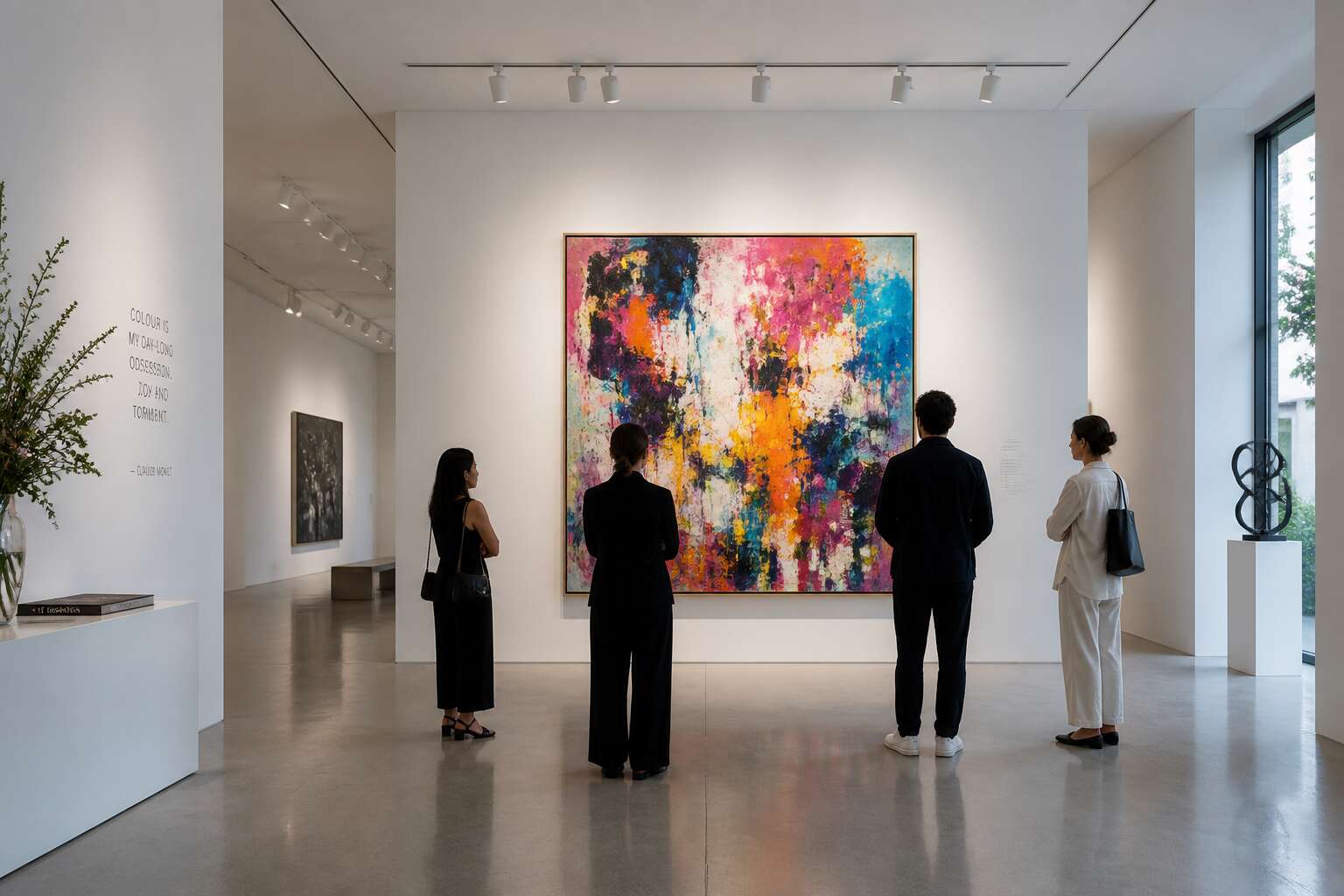
Foundations of Display Curation
Defining the Artistic Thesis
A room filled with objects is not yet an exhibition. It is a storage space, a jumble of voices speaking over one another. The foundational work of display curation begins with the act of listening, of finding the single, unifying note that makes the collection sing in harmony. This is the artistic thesis. It is not a theme like “nature” or “the city.” It is a specific argument, a way of seeing that the exhibition art will articulate through space and material.
The curatorial thesis acts as a silent guide for every decision, from the color of the walls to the sequence of the works. It dictates the rhythm of the visitor’s journey and the emotional cadence of the experience. To define it, a curator must be both a detective and an editor. They must ask what the pieces are truly discussing with one another and ignore the noise of irrelevant detailschers. Effective thesis definition involves:
– Selecting key works that serve as the primary speakers for the narrative.
– Identifying the core dialogue between these works and their historical context.
– Determining the physical flow that best translates this dialogue into a spatial language.
Once defined, this thesis is not a tagline printed on a pamphlet. It is the underlying architecture of the experience, the logic that separates a collection of objects from a moment of exhibition art. With a tight, deliberate thesis, the viewers sense a hidden order, a focused intent that guides their attention and allows for a genuine connection with the work on display.
The Role of Space and Context
The same painting can feel monumental in a cramped corridor and lost inside a cavernous hall. Space is a decisive element of curation. I have seen a modest sculpture transform into a protagonist simply because the room allowed it.
Context works through proximity and interruption. Two pieces facing each other create a dialogue that neither could sustain alone. A shift in lighting alters the emotional temperature. These decisions are quiet, deliberate acts of curation!
- Control sightlines to manage attention.
- Use negative space as a pause.
- Let architecture guide the visitor’s pace.
When these elements align, the viewer stops reading labels and starts feeling the work. That is the real foundation of exhibition art.
Navigating Audience Perception
Visitors spend an average of eight seconds before a work before their attention drifts. That number drops to three when the display feels cluttered. Curation is the quiet engineering of that attention span.
I have learned that pacing decides everything. A gallery that moves too fast leaves no room for reflection, while one that drags turns viewers into passive wanderers. The trick is to treat the visitor’s body as part of the installation.
– Light governs focus, so steer it toward the work’s critical details.
– Height adjusts power, with eye-level pieces feeling intimate and raised ones feeling authoritative.
– Sound, even ambient noise, shapes the emotional register of the room.
Bad curation fails when it ignores how people actually move. A piece that demands close inspection loses its effect if placed near a busy exit. That is the failure mode of exhibition art: it becomes scenery rather than confrontation. The viewer walks away with a blank stare, and we have wasted their valuable time.
The Curatorial Workflow and Artist Collaboration
Research and Concept Development
Somewhere between the artist’s studio and the gallery floor, a peculiar negotiation takes place. The curator reads the artist’s working methods before shaping any narrative. Research and concept development starts with primary sources, not press releases.
A productive workflow often includes:
- Reviewing studio archives and process documentation
- Interviewing artists about their decision making
- Testing interpretations against available evidence
- Documenting every conversation for later reference
In South Africa, where exhibition art carries layered cultural references, this collaboration demands patience. I have learned to discard a curatorial concept after one honest studio visit. The curatorial workflow is a process of discovery, not confirmation.
Artist collaboration provides the research material. The concept develops from the work itself, and the exhibition art succeeds when that lineage remains visible.
Artist Selection and Original Works
Selecting the right artist for an exhibition project is a matter of intuition and evidence. I have walked away from beautiful work that carried no curatorial tension. Original works demand a kind of trust. The artist brings a fragile object into the world, and the curator must protect that fragility while placing it in conversation with other pieces.
My workflow hinges on three questions:
- Does this work hold its own weight?
- Can the exhibition art support multiple readings?
- Will the artist and I remain honest when the work fails?
Artist collaboration is not a courtesy! It is the mechanism that keeps original works alive.
Bridging Vision with Exhibition Logistics
Few things in this field feel as tenuous as the moment a concept meets the physical gallery floor. The curatorial workflow is less a linear path and more a series of deliberate checkpoints where vision gets tested against reality. I have seen projects stall because the logistics were treated as an afterthought, a necessary evil to be handled after the thesis was locked. That is a mistake. Shipping timelines, wall dimensions, and lighting rigs are not administrative chores; they are the scaffolding that allows original works to breathe.
Collaboration here is a constant negotiation. The artist might propose a piece that relies on ambient sound, but the adjacent exhibition art requires silence. Those conflicts do not resolve themselves. We build the bridge through precise, documented conversations about constraints, not just possibilities.
– Scheduled site visits to confirm technical specs against the actual architecture.
– A shared digital folder for every material list, installation diagram, and insurance certificate.
– An agreed protocol for handling unexpected damage or malfunction during the run.
The real skill lies in translating poetic intention into a rigid production schedule without flattening the spark. I find that protecting the artist from the grunt work of freight bookings and paint touch-ups allows them to stay focused on the fragile core of their practice. When the rhythm is right, the logistics become invisible, and the exhibition art speaks for itself.
Legal and Provenance Considerations
Every work that enters a gallery carries a paper trail. Provenance is not a dusty archive practice; it verifies authenticity. When artist collaboration intensifies during the curatorial workflow, legal clarity protects both the maker and the institution. Loaned pieces demand precise agreements around insurance, reproduction rights, and installation modifications. A signed certificate of authenticity means nothing if the chain of custody is broken. In South Africa, cultural heritage regulations add another layer of scrutiny for contested origins.
I watched an exhibition stall because a consignment agreement lacked a clause for humidity control. The conversation had revolved around aesthetics, never liability. That is where the workflow must shift:
– Confirm title transfer or loan terms before any physical movement.
– Document condition reports with dated, time-stamped photographs.
– Secure export permits when a piece crosses provincial borders.
Without these checkpoints, the exhibition art loses its market standing. Artists rely on curators to protect their legal integrity, and the exhibition art itself becomes vulnerable to dispute.
Spatial Design and Installation Dynamics
Architectural Considerations for Display
In Johannesburg, a gallery’s ceiling height can change how viewers read a sculpture. Spatial design is not a backdrop; it is the silent engine of exhibition art. Architectural considerations, from load-bearing walls to sightlines, determine what visitors feel first. I once saw a large canvas installed in a corridor so narrow that the paint seemed to press against your chest. That effect came from deliberate spatial planning, not from the work itself! For artists and curators in South Africa, the challenge is often the found space. Old warehouses, converted homes, and municipal buildings each demand different installation dynamics.
Floor stability, lighting angles, and pedestrian flow are the grammar that makes exhibition art legible. Skip them, and even the strongest thesis loses its voice. These factors are not optional extras; they are the quiet force behind every memorable display.
Flow, Sightlines, and Traffic Patterns
Flow determines how visitors encounter exhibition art. In Johannesburg’s found spaces, I watch traffic patterns before hanging a single piece. A doorway that feeds a narrow hall forces single-file movement, which changes viewing time per work.
Sightlines command attention. When a sculpture sits at the junction of two corridors, it pulls the eye. But if a pillar blocks the angle, that same work disappears entirely.
- Measure pedestrian speed at peak hours
- Map where people naturally pause
- Test sightlines from every entry point
Installation dynamics are practical. The visitor’s path shapes the memory of the show. Get the movement wrong, and the strongest piece fights the room. Get it right, and the room fades while exhibition art holds the moment.
Lighting as a Narrative Tool
Light is the quietest tool in exhibition art, yet it shapes every decision a visitor makes. In Johannesburg galleries, I have seen a single spotlight transform a modest canvas into a commanding presence. The eye follows brightness before it registers colour or form.
A narrow beam creates intimacy. A broad wash invites exploration. When working in Cape Town warehouses with high ceilings and raw concrete, I rely on adjustable track lighting to carve out zones of attention. The light becomes a structural element, defining space without adding a single wall.
Shadows matter just as much as illumination. They give depth to sculpture and relief to flat works.
- Use warm bulbs for organic pieces and cool light for graphic works
- Position fixtures to avoid glare on glass or acrylic surfaces
- Dim the edges of a room to push focus toward the art
Lighting is a narrative tool that guides tempo. A bright wall draws immediate attention. A dim corner invites slow curiosity. When done right, the visitor forgets the source of illumination entirely and remembers only the work itself. That is the goal. The narrative emerges through what is revealed and what stays hidden in exhibition art.
Wall Text, Labels, and Interpretive Signage
Spatial design determines how visitors encounter wall text. In Johannesburg galleries, I place labels at a consistent height, around 120 centimetres, so reading never interrupts the visual flow. The physical installation of a work dictates whether a viewer reads first or looks first. That sequence shapes their interpretation of exhibition art.
Interpretive signage should answer a question before the visitor asks it. A short label about material or provenance adds context without dictating meaning. For group shows, I coordinate label placement with sightlines, ensuring text never competes with the artwork itself.
- Use a sans-serif font at 10 point minimum
- Keep labels under 60 words
- Position signs on the same wall as the work
When spatial dynamics and wall text work in tandem, the viewer moves confidently!
Interactive Elements and Immersive Environments
A single motion sensor can shift a visitor’s path through the entire gallery. In Johannesburg, I have watched people pause mid stride when a shadow triggers a quiet hum. That pause reorders the space around them. Interactive elements instigate new installation dynamics.
Immersive environments ask for careful calibration. Projected light, floor texture, and spatial audio must work together without dominating the artwork. Curators test these elements in situ, adjusting intensity until the acoustics and sightlines settle. For exhibition art, the distinction between viewer and work becomes less fixed.
- Place sensors at varied heights to accommodate different audiences
- Keep interactive zones clear of structural pillars
- Test audio levels at every corner of the room
When these dynamics align, the gallery operates as a dynamic system. Visitors move, respond, and shape the final meaning. That is the value of exhibition art made interactive.
Sustainability and Reusability of Display Structures
The most honest moment in an exhibition is often the dismantling. That is when you discover which structures were designed to survive and which were staged purely for the opening night. In Johannesburg, I have watched exhibition art outlast its own pedestals. The artwork gets the press release. The plinth gets the skip bin.
Spatial design and installation dynamics shift when a structure is built to be dismantled. Modular walls, adjustable rails, and powder-coated frames manage a second showing without shame. The materials that keep their dignity across multiple installations are unglamorous:
- steel brackets with standard fixings
- timber battens that tolerate fresh paint
- panel systems that reconfigure without new holes
Sustainability in exhibition art becomes a matter of engineering, not sentiment. When a structure can be unbolted, repainted, and rearranged, the next curator inherits a toolkit instead of a headache.
Digital Integration and the Modern Viewer
Virtual Tours and Online Galleries
A screen is now the first gallery wall for many South Africans. This reality forces curators to treat exhibition art as something that exists in two places at once. The physical object and its digital rendering demand separate attention.
Virtual tours and online galleries extend a show’s reach to towns without museum infrastructure. They also change how viewers behave. People click, pause, and skip. Curators must respond with deliberate choices:
- image resolution that holds up on cheap data
- captions that work without hover
- paths that allow for slow looking
These details shape memory more than any plaque. Exhibition art gains a new audience, one built for the scroll.
Integrating Multimedia into the Physical Space
Virtual tours and online galleries fundamentally expand the audience for exhibition art. They remove the barriers of geography and mobility, granting access to those who cannot visit a physical space. This digital integration transforms the viewing experience from a passive activity into an active exploration. Multimedia elements, such as video commentary and audio guides, provide context that a wall label cannot offer. This also creates a means for impromptu curation, allowing followers to repost works and drive significant engagement. As these platforms develop, they become keys to unlocking a more inclusive, dynamic, and persistent relationship between the institution, the artist, and a global public.
Data-Driven Visitor Tracking and Feedback
A single visitor’s pause before a canvas lasts only seconds, yet most galleries never measure it. Data-driven visitor tracking now captures these fleeting moments, converting footfall into precise patterns. In South Africa, where exhibition art competes with constant digital noise, this feedback becomes essential.
Heatmaps reveal where crowds gather and where they avoid. Dwell time measures the duration of attention. Exit surveys, entered into tablets, carry the direct words of response. These tools do not replace curatorial instinct; they sharpen it. What power this is!
- Sensor data on movement patterns
- Anonymous feedback terminals
- Social media sentiment analysis
For the modern viewer, their presence becomes part of the record. Every click, every lingering step, shapes the next iteration of the exhibition.
Marketing, Programming, and Audience Retention
Pre-Launch Campaign Strategies
Before a single work is hung, the quiet machinery of anticipation must begin its work. The pre-launch phase is not about volume, but about strategic resonance. For exhibition art, the campaign is a promise of an encounter, a transaction of attention between the artist and the future viewer. In South Africa, where cultural calendars are dense and competing, the opening day is won or lost in the weeks prior. The goal is to create a sense of private discovery, where the audience feels they are stepping into a secret before the public claim.
Marketing during this period should be less about broad strokes and more about precise intimacy. Instead of a spray of generic press releases, consider a segmented approach that speaks directly to the psychographic of the collector, the academic, and the casual enthusiast. Use the tension of the unseen. The narrative is not merely that a show is coming, but that a specific problem of form or meaning is being solved. This is the hook, the cerebral ladder that leads to the gallery door.
Programming is the intellectual architecture that supports the visual work. These are not add-ons, but the very scaffolding of the event’s identity. A well designed panel discussion or a curator’s walkabout functions as a secondary artwork, adding context to the raw visual stimulus. This keeps the exhibition art relevant in the public discourse beyond the immediate visual appeal. It provides a reason for the media to write a second story, moving the conversation from “what to see” to “what it means”.
The first layer of audience retention, however, is found in the data of the campaign itself. Track the silent majority, those who view the online content but do not immediately register. This is the phantom visitor, the one who needs a slight nudge. A weekly email that reveals a specific detail of the installation process, or a quote from the artist about a single piece, can convert a passive observer into a committed attendee. These small, intimate gestures build a relationship that a generic “opening night” invitation cannot. The strategy is to build a cohort of individuals who feel personally invested in the success of the show before they ever step inside the venue.
Private Previews and VIP Events
Private previews shift the dynamic from public spectacle to selective encounter. For exhibition art, a closed-door evening creates urgency that mass advertising cannot match. Marketing focuses on personal invitations, not press releases. Include a brief list of what guests will experience.
- An unreleased catalogue excerpt
- A first glance at the installation process
- A direct Q&A with the artist
Programming for VIP events should offer layered access. A curator’s walkthrough, or a short talk on material choices, gives context that enriches the viewing. Audience retention here depends on follow-up communication. Send a hand-written note referencing the guest’s interest in a specific piece. That gesture creates a relationship stronger than any social media post. The goal is to convert these visitors into repeat attendees, and eventually, advocates for your exhibition art.
Educational Workshops and Guided Tours
Marketing for exhibition art rarely succeeds through volume alone. Programmes that pair thematic tours with hands-on workshops give visitors a reason to return. Instead of a one-off viewing, structure the season around layered experiences. A guided tour introduces the context, while a practical workshop invites personal response. This combination builds audience retention because people remember what they made, not just what they saw.
Consider workshops that connect directly to the works on display:
– A cyanotype print session after a photography exhibition
– A clay modelling class following a sculpture show
– A life-drawing session tied to a portrait collection
These activities convert passive visitors into active participants. For retention, follow up after each event with a simple email asking for feedback. Offer a loyalty card for repeat attendees. Those consistent touches keep your exhibition art at the front of their minds, turning a single visit into an ongoing relationship.
Post-Exhibition Legacy and Documentation
A show that closes without documentation leaves no trace. Marketing for exhibition art should therefore include a legacy plan from the start. Programming the final weeks of a run with recorded curator talks or behind-the-scenes sessions gives media outlets something to share after the closing date. Audience retention carries over when visitors can revisit the work through these materials.
A practical documentation set might include:
- a published catalogue with critical essays
- a photographic archive of the installation
- recorded walkthroughs or artist interviews
These assets become the foundation for the next campaign, giving future audiences a reason to trust your exhibition art before they even enter the gallery. In South Africa, where travel distances are significant, this digital residue matters. It also serves as a historical record for artists and funders, proving the reach and impact of the programme long after the walls are repainted.
Community Partnerships and Cross-Promotion
In South Africa, a gallery becomes a meeting place when programming reaches beyond its walls. Partnering with local businesses, cultural festivals, and university departments turns a single exhibition art event into a shared investment. These collaborations widen the circle of ownership, so audiences return not only for the work but for the conversations that continue around it.
Cross-promotion works best when each partner brings a distinct audience. A coffee roaster, a jazz ensemble, or a community garden can host satellite discussions that mirror the show’s themes. This layered approach to audience retention rewards visitors who return, creating a rhythm that feels both familiar and exploratory.
To keep momentum, consider:
- Co-hosted opening nights with partner organisations
- Shared social media takeovers and newsletter swaps
- Seasonal passes distributed through community networks



0 Comments