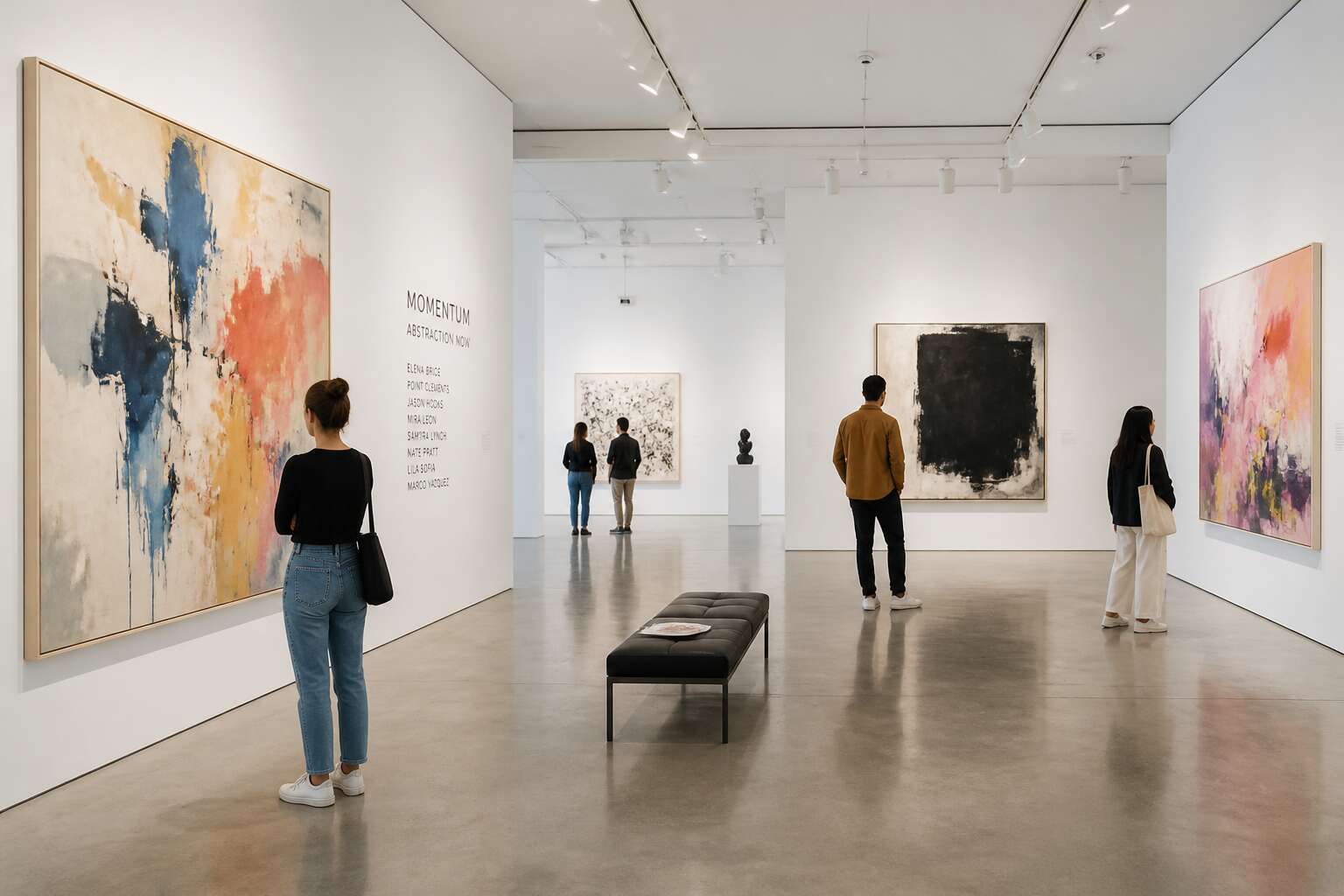
Defining Exhibitions in the Art World
What Constitutes an Exhibition
An exhibition is not a mere gathering of objects. It is a deliberate act, a story told through walls and light. To constitute an exhibition in the art world, three conditions must be met:
- Intent: a curator or artist selects works for a reason.
- Temporality: an exhibition exists for a finite span, after which it dissolves.
- Audience: without witnesses, even the finest arrangement becomes a private mausoleum.
This creates the difference between exhibition and gallery, because a gallery can exist as a physical space, but an exhibition only exists as an event. I have seen works hang in a gallery for years, barely remembered; in an exhibition, they speak for a season and fall silent! That temporality shapes how we encounter art.
Common Exhibition Formats and Types
Johannesburg’s art scene offers a living case study of the difference between exhibition and gallery. A gallery persists as a commercial address. An exhibition manifests as a curated moment, bound to a season. Common formats reveal this distinction clearly.
Survey exhibitions gather an artist’s decades into a single narrative. Biennials stretch across months and multiple venues. Pop-up shows transform disused warehouses into ephemeral encounter spaces. Each format carries its own rhythm and audience.
Practical variations include:
- Group exhibitions, which juxtapose several artists around a shared theme
- Solo shows, which concentrate on one practitioner’s vision
- Retrospectives, which reassess a career with hindsight
- Site-specific installations, which respond to the architecture around them
All of these formats share a closing date. That deadline is the core difference between exhibition and gallery. A gallery can hold inventory indefinitely; an exhibition must conclude. This temporal pressure changes how collectors in Cape Town, Durban, and Pretoria decide to visit.
The Temporary Nature and Curatorial Themes
An exhibition is a thesis made visible. Curators select works to argue a point, whether about identity, history, or material itself. The temporary nature forces decisions. You must see it now, because next month the walls will change. I have learned to plan my weekends around opening dates.
This urgency marks the difference between exhibition and gallery. A gallery holds steady. An exhibition lives on borrowed time.
Curatorial themes give shape to this fleeting condition:
- A theme can interrogate a neighbourhood’s shifting character
- It can pair emerging voices with established names
- It can trace a single material across decades
Each choice creates a finite experience. The closing date is not an administrative detail. It defines the exhibition. That is the practical difference between exhibition and gallery.
Where Exhibitions Typically Take Place
Calling something an exhibition is a bold claim. It suggests a deliberate gathering of objects with a point to prove. In the art world, an exhibition is a curated event, a temporary assembly that exists for a set period. The difference between exhibition and gallery is one of time and intent. A gallery is a space; an exhibition is an occurrence.
Where do these occurrences happen? Museums, obviously. But also in repurposed warehouses, empty office blocks, and even the odd garage in Maboneng. Galleries host them, but exhibitions have a habit of escaping the white cube. They turn up in:
– abandoned mines
– university corridors
– shipping containers at a harbour
Each venue alters the work. A sculpture in a sterile gallery reads differently than the same sculpture rusting in a parking lot. The venue is part of the argument. That is the difference between exhibition and gallery; one is the stage, the other is the performance.
Understanding Galleries and Their Purpose
Types of Galleries: Commercial, Private, and Public
In the art world, a gallery is not a room that fills and empties; it is a vessel with a defined purpose! To grasp the difference between exhibition and gallery, one must first understand that a gallery persists while an exhibition fades. A gallery operates as a permanent structure, housing art and nurturing artists over months or years.
Galleries split into three main types, each with distinct functions:
- Commercial galleries function as salesrooms, connecting collectors with living artists.
- Private galleries showcase personal collections, often behind closed doors or by appointment.
- Public galleries, think of the Johannesburg Art Gallery or the Zeitz MOCAA, are funded by the state and serve entire communities.
This stability is the core of the difference between exhibition and gallery. Exhibitions come and go, but galleries remain. They are the steady homes where art lives between events, and their purpose shapes how we encounter creative work.
The Commercial Role of Art Galleries
A gallery is a permanent space. While an exhibition closes on a date, the gallery stays open! This difference between exhibition and gallery is most visible in the commercial sphere. Commercial galleries serve as economic intermediaries for living artists, setting prices, managing sales, and building collector relationships. They handle the long work of developing a career beyond a single showcase.
For a commercial gallery, daily operations include:
- Valuation and pricing of artwork
- Maintenance of artist records and archives
- Coordination with museums and private collectors
These functions persist between exhibitions. The exhibition brings visibility; the gallery converts that visibility into sustained financial and professional exchange. One is an event, the other is an institution.
Gallery Representation and Artist Contracts
Walk into a gallery after its latest exhibition has closed. The white walls are bare, yet the space still conducts business. Understanding galleries and their purpose starts with the artist contract, a document that turns a temporary display into a lasting professional bond. Representation is not a simple handshake; it is a detailed agreement.
- Commission rates on every sale
- Scheduling of future exhibitions
- Copyright and reproduction permissions
These terms define the daily reality for artists and dealers. In South Africa, the difference between exhibition and gallery shows in this paperwork. An exhibition closes on a fixed date. A gallery carries on through market fluctuations and career shifts. The contract secures that continuity, so an artist’s visibility becomes professional stability.
How Galleries Generate Revenue
The endurance of a gallery depends on a single, unglamorous function: converting cultural visibility into financial liquidity. An exhibition is a static event, a fixed interval of time with a closing date. A gallery operates as a persistent economic entity. Its purpose is to generate revenue across multiple channels, not merely to hang works on a wall.
Most institutions rely on a handful of revenue streams!
- Primary sales with a commission margin that typically ranges between 30% and 50%.
- Secondary market sales of established artists, where the gallery acts as a broker.
- Art fair participation, which often yields higher-priced transactions than a local show.
- Corporate leasing or short-term installations for businesses seeking cultural capital.
This diversity explains the difference between exhibition and gallery. A single exhibition can lose money. The gallery absorbs that loss through advisory fees, valuation services, or a robust collector list. In South Africa, a gallery in Cape Town or Sandton survives by selling the artist’s future, not the current canvases alone.
The Difference Between a Gallery and a Museum
Ask a curator to explain the difference between exhibition and gallery, and you will get a lecture. Ask a gallerist, and they will point at the price list.
A museum collects and preserves objects for posterity. A gallery sells. This is the core distinction, and it shapes every decision behind the walls. In South Africa, the line can blur. A public gallery like the Iziko South African National Gallery operates with museum logic, yet it still stages temporary shows. A commercial gallery in Maboneng or Constantia, however, exists to move work into private hands.
Consider the visitor experience:
- A museum asks you to look at history.
- A gallery asks you to imagine ownership.
- A museum protects the past.
- A gallery brokers the future.
An exhibition is a moment. A gallery is a persistent economic entity that keeps running after the lights dim. The difference between exhibition and gallery is not about wall space. It is about institutional intent.
Key Structural Distinctions
Permanence vs. Temporality
Consider any gallery. The floor stays. The lights stay. The reception desk never moves. What changes is the art on the walls. That permanence is the backbone of the difference between exhibition and gallery. An exhibition is a temporary inhabitant, a guest that stays for six weeks and leaves.
I have watched a single gallery host a retrospective, then a group show, then a video piece. The room remained identical. Only the meaning changed! This is why collectors trust galleries and why visitors feel urgency for exhibitions.
- Galleries: permanent location, permanent business license.
- Exhibitions: fixed opening and closing dates.
- Galleries: ongoing program of exhibitions.
The structural distinction is simple. One space persists. The other event fades.
Curatorial Approach and Selection Process
A gallery curates over years. Its selection process favours artists who can sustain a decade of shows. Each piece enters a permanent context, so the curatorial approach is architectural, building slowly. The space stays fixed; the choices must survive that fixity.
An exhibition starts with a theme. The curator assembles works that answer a question. Selection is urgent and often borrowed. Works arrive, hang, and vanish within weeks. In my experience, this is where the difference between exhibition and gallery becomes visible in practice.
- Galleries select for sustained careers.
- Exhibitions select for immediate resonance.
- Galleries build relationships with collectors.
- Exhibitions build arguments with objects.
The first values permanence. The second values intensity.
Ownership and Financial Models
Ownership separates them structurally. A gallery holds stock. It buys work outright, or takes pieces on consignment, and carries the financial risk of keeping them. Its revenue comes from selling that inventory over time, often to the same collectors returning year after year. An exhibition rarely owns what it shows.
Exhibitions borrow. Loans arrive from private collections, estates, or other institutions, insured for the duration of their stay. Funding comes from grants, ticket sales, or sponsorship, not from a sale at the end of the corridor. This changes how works are handled and how risk is measured.
- Galleries price for a market and negotiate directly with buyers.
- Exhibitions operate on fixed budgets and return every piece once the run ends.
To my mind, the difference between exhibition and gallery becomes clear when you track the funding. One model rewards patience and long relationships. The other rewards a single, concentrated moment of public attention.
The Role of Sales and Commerce
In a gallery, every piece has a price, but that price stays hidden until a conversation begins. I have watched collectors circle a painting for months before they speak its value aloud. An exhibition, by contrast, presents works for public viewing, not private sale.
Sales in a gallery are slow, deliberate, and relational. Exhibition commerce is often absent altogether. If a shop exists, it sells prints and catalogues, not the central works.
- Galleries hold stock and negotiate for weeks.
- Exhibitions open and close with no price tag on the wall.
This structural distinction changes how a visitor moves. The difference between exhibition and gallery is visible in every step. One browses with intent to possess. The other merely witnesses what will soon vanish.
Viewer Engagement and Expectations
The architecture itself enforces the difference between exhibition and gallery. In a gallery, walls are permanent fixtures, with lighting calibrated for repeated viewing. An exhibition, however, often springs up in a raw warehouse, a disused church, or a shipping container. The temporary framework alters how you step.
I find viewers in an exhibition move with a quiet urgency, knowing the piece will be dismantled. In a gallery, the visitor saunters, because the artwork will remain. That structural impermanence breeds a different kind of attention. Consider the expectations!
- Gallery etiquette demands quiet contemplation and negotiation.
- Exhibition spaces encourage immediate, visceral reaction.
This distinction grants the observer a distinct physical license, one shaped by the promise of disappearance.
Primary vs. Secondary Art Markets
Here is where the difference between exhibition and gallery gets properly financial. The primary market is where art first meets money, fresh from the studio, sold through a gallery or an exhibition debut. The secondary market is the resale circuit, where work changes hands again at auction or through private dealers.
Exhibitions mostly operate in the primary market. Galleries can straddle both. The structural distinction is who sets the price. In the primary market, the gallery sets the price. In the secondary market, the market does it for you, often with a hammer and a lot of nervous hand-wringing.
- Primary market: first sale, gallery sets the price.
- Secondary market: resale, market determines value.
The Audience Experience Compared
How Visitors Navigate Exhibitions
A 2023 visitor study found that the average gallery visitor spends under four minutes per artwork, while exhibition attendees often dwell twice as long. That metric reveals a basic difference between exhibition and gallery navigation. In a gallery, you wander. Sparse walls and controlled lighting encourage a slow, independent scan. You are searching, even subconsciously.
An exhibition, however, pushes you forward. The sequence of pieces creates a directive. You move because the narrative moves. The curatorial logic dictates your steps, and your experience becomes a procession. Exhibition visitors adopt specific navigation patterns:
- The linear route, following the chronology of the works.
- The thematic loop, circling back to compare related pieces.
- The impulsive drift, where a focal point pulls you off the intended path.
That difference between exhibition and gallery navigation changes how you remember the art. A gallery leaves a memory of a single standout piece. An exhibition leaves a memory of an entire argument. The space dictates your pace, your attention, and your takeaway.
Gallery Etiquette and Sales Conversations
In a Johannesburg gallery, the silence has a purpose. Visitors speak in low tones, hands clasped behind their backs. The etiquette assumes reverence. You ask before touching, you avoid interrupting a collector’s private viewing, and you wait for the gallerist to approach you.
An exhibition draws a different crowd. The atmosphere is social. People discuss, debate, and move in groups. The difference between exhibition and gallery settings shapes how conversation flows.
Gallery sales conversations follow a script:
- The gallerist opens with a question about your response to a piece.
- They follow with provenance and artist background.
- They close with pricing and availability.
Exhibition conversations rarely mention price. They focus on meaning, context, and the curator’s intent. That is the quiet difference between exhibition and gallery interaction. One sells art. The other sells an idea.
Educational Programming and Public Outreach
Walk into a public exhibition at the Wits Art Museum and you’ll see school groups clustered around a sculpture, sketchbooks open. The educational programming here is designed for wide access: guided tours, curator walkabouts, and workshops for children. Public outreach extends the exhibition’s themes into surrounding communities, inviting participation beyond the gallery walls.
Galleries operate differently. Their public programming often serves a narrower purpose, building relationships with serious buyers. A gallery might host a private dinner or a closed-door viewing instead of an open workshop. The difference between exhibition and gallery is most visible in who participates and what they take away.
Exhibitions invite questions. Galleries invite commitment.
Artists, Curators, and Institutional Roles
The Artist’s Relationship with Galleries
The artist’s relationship with a gallery is a precise arrangement of trust and utility. A curator’s judgment can shape a career or close a door, while the institution’s reputation lends weight to every brushstroke. I have watched artists navigate this terrain with equal parts hope and calculation.
For many, the difference between exhibition and gallery lies in this daily negotiation. The exhibition is the temporary altar, the gallery the ongoing tribunal. Artists must weigh several factors when seeking representation:
– The gallery’s audience and whether it matches their own trajectory
– The curator’s vision and if it aligns with the work’s intent
– The institution’s history and what it promises beyond a single show
This bond rarely follows a clean script. Some artists flourish under constant institutional attention; others prefer the quiet distance of a private studio. Both patterns shape what viewers ultimately encounter on the walls.
How Curators Shape Exhibition Narratives
What makes one exhibition memorable and another forgettable? Often the difference between exhibition and gallery appears through curatorial decisions. A curator selects, arranges, and writes explanations. These choices turn separate works into a single narrative.
Curators set the sequence of viewing. They decide which pieces face each other and which walls remain empty. Their narrative can make a modest work feel essential, or leave a powerful piece isolated. In South Africa, I have seen curatorial roles vary, yet the basic task stays consistent: build meaning from separate objects.
Three approaches guide this:
- Through chronological layouts that trace an artist’s development.
- Through thematic groupings that compare distinct works.
- Through juxtaposition that creates unexpected conversations.
Thus, the difference between exhibition and gallery becomes clear in this curatorial act. An exhibition is the narrative moment. A gallery is the enduring container that hosts those moments repeatedly!
Collectors, Critics, and the Art Market Ecosystem
In South Africa, the difference between exhibition and gallery often rests on the people involved. Artists create works, but curators decide how those works meet the public. Collectors and critics then add value and context to what hangs on the walls.
Institutional roles shape this dynamic. A public gallery may hold a permanent collection, while an exhibition becomes a temporary conversation. The difference between exhibition and gallery becomes visible when a curator invites a critic to interpret a new piece, or when a collector loans work to a non commercial space.
- Artists provide the raw vision.
- Curators build the narrative.
- Collectors fund the future.
- Critics frame the public conversation.
Each role relies on the others, and the exhibition becomes the moment where all these forces meet.
Career Implications for Emerging Artists
For an emerging artist in South Africa, the difference between exhibition and gallery decides who pays for crating, who handles insurance, and who introduces you to collectors. A gallery takes on ongoing responsibility. An exhibition is a temporary arrangement, often with a clear start and end date.
Curators control institutional access. They decide if your work enters a public collection or a commercial program. Artists who understand this distinction prepare differently. A curator at a public gallery might value research and process. A commercial gallery curator focuses on marketability.
- Gallery representation offers contractual support and repeat sales.
- Exhibition opportunities provide exposure without long term commitment.
Emerging artists must assess each opportunity. Institutional roles vary, and your local context matters. Johannesburg and Cape Town have different norms. Clarity about the difference between exhibition and gallery prevents costly mistakes.
How Exhibitions and Galleries Intersect
Galleries Hosting Exhibitions In-House
When a gallery curates a show within its own walls, the boundary dissolves. The difference between exhibition and gallery narrows, because the space becomes a stage for a temporary narrative.
These in-house exhibitions often take several forms:
- Rotating collections from represented artists
- Site-specific installations responding to the architecture
- Group shows that test new curatorial voices
Each format serves a dual purpose. It gives artists a platform, and it gives the gallery a chance to experiment with its identity. I have seen small commercial spaces transform into immersive worlds overnight! The gallery remains a business, but the exhibition adds a layer of experimentation.
Museum Exhibitions vs. Gallery Shows
Museum exhibitions and gallery shows often borrow from each other, yet the difference between exhibition and gallery remains visible in their approach. A museum exhibition builds a long argument across several rooms, while a gallery show condenses a thesis into a single space.
That intersection becomes fascinating when a gallery hosts a museum-style retrospective. Visitors might see loans, wall texts, and a scholarly tone. Meanwhile, museums sometimes adopt the commercial gallery’s urgency, offering limited runs and sales desks. The crossover changes expectations.
Key intersections include:
- Curatorial authority shifting between institutions
- Audience assumptions about purchase and preservation
- Time pressure altering how works are read
Both formats ultimately shape perception, but their intentions remain distinct.
Art Fairs and the Hybrid Model
Art fairs occupy a hybrid space. A dealer brings a solo presentation that reads like a gallery show, yet the booth functions as a temporary exhibition. The difference between exhibition and gallery blurs when collectors browse with museum-level intensity.
At FNB Art Joburg, this hybrid model is on full display. Galleries curate booths with thematic precision, and visitors compare works across stands. Commercial urgency coexists with curatorial care. I have watched collectors linger over a single piece, reading the wall text as if they stood in a museum corridor.
Some fairs commission large-scale installations that exist outside any gallery inventory. Those pieces are exhibitions in the purest sense, even within a marketplace.
Digital Galleries and Virtual Exhibitions
Digital galleries and virtual exhibitions reshape the difference between exhibition and gallery through time and access. A virtual exhibition often lasts a few weeks, curated around a specific argument, while the gallery’s online portal remains a standing archive of represented artists. I have watched Johannesburg spaces experiment with immersive 3D tours, yet the commercial permanence of the gallery never disappears.
Virtual shows function like this:
- They remove physical distance.
- They cost less to stage.
- They extend a temporary presentation into an indefinite digital trace.
That lingering trace tests the boundary, but the gallery still sells behind the scenes.
Pop-Up Exhibitions and Alternative Spaces
Walk into a pop-up in a Cape Town warehouse and you will not find a price list. That absence captures the difference between exhibition and gallery more clearly than any definition. A pop-up lives for a weekend, then vanishes. No permanent structure, no artist roster, no sales pressure. Curators assert a theme, hang the work, and open the doors.
Alternative spaces operate with different rules. A converted Durban warehouse might host regular shows, build a following, and quietly facilitate private sales. It resembles a gallery but avoids the contracts and representation that define gallery practice. The difference between exhibition and gallery hinges on intention rather than walls.
Pop-ups offer clear advantages:
- They test an audience’s appetite for a concept
- They give emerging artists visibility outside traditional circuits
- They allow curators to take risks a gallery would refuse
Pop-ups keep the boundary in motion.
The Evolving Relationship in Contemporary Practice
The difference between exhibition and gallery is becoming less distinct as contemporary practice evolves. Galleries increasingly host temporary exhibitions that function like experimental pop-ups, while exhibition spaces adopt the structural habits of commercial venues.
- Galleries commission artists for site specific installations without long term contracts
- Exhibition spaces offer sales through private negotiation
- Both use digital platforms to extend their reach beyond physical walls
This overlap means artists no longer need to choose sides. A single project can move from a collector’s private viewing room to a public exhibition, reshaping how value is assigned along the way!




0 Comments